
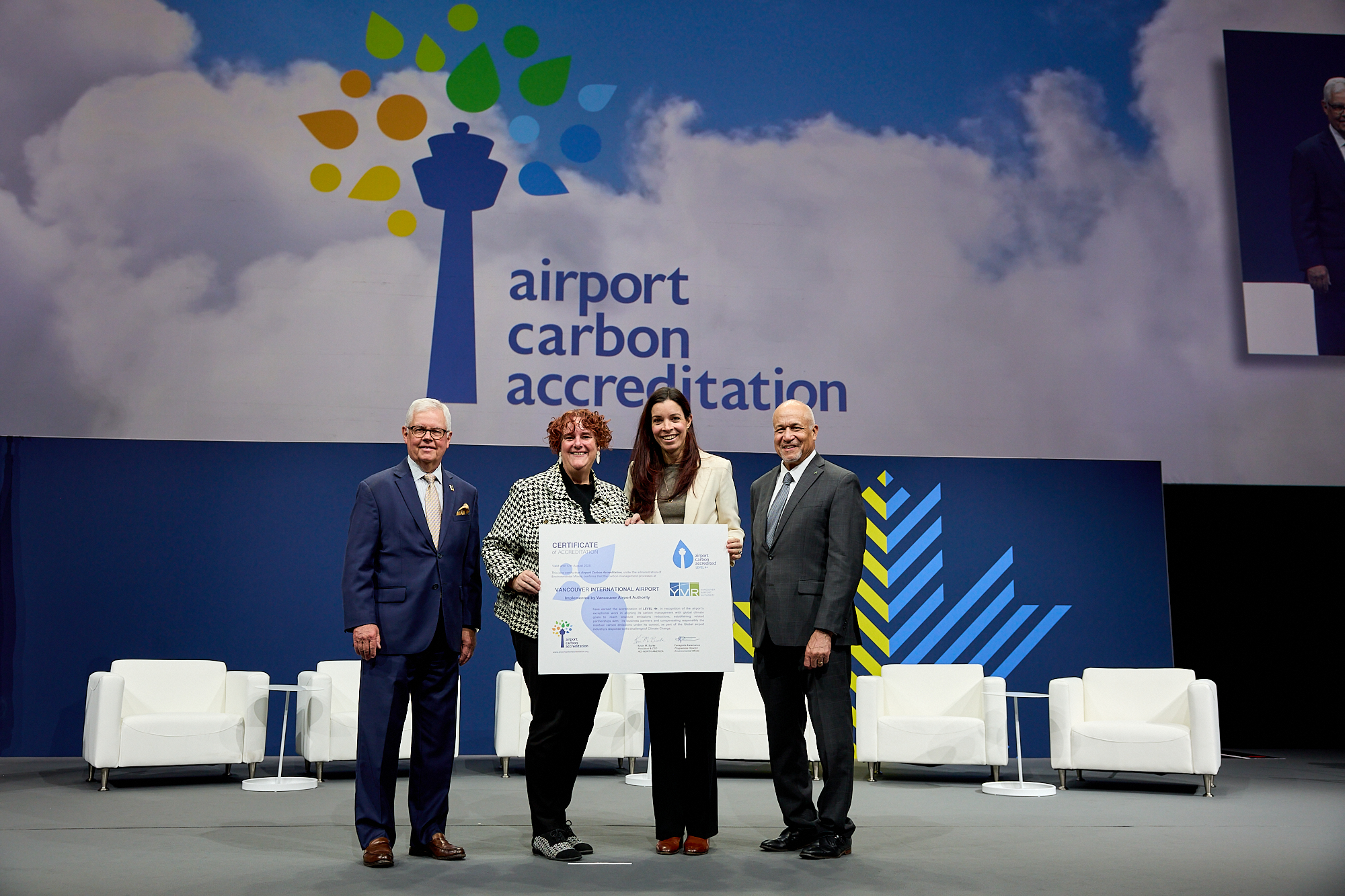
TORONTO, ON – Airports Council International – North America (ACI-NA), the trade association representing commercial service airports in the United States and Canada, recognized 77 North American airports for achieving Airport Carbon Accreditation, an independent program that evaluates and verifies airport efforts to manage and reduce CO₂ emissions. The recipients were honored during the annual awards presentation on Monday, October 27, at the 2025 ACI-NA & ACI World Annual General Assembly, Conference, and Exhibition in Toronto, Ontario.
“Airports continued to raise the bar in environmental stewardship, and I am proud to recognize this year’s accredited airports for their progress,” said ACI-NA President and CEO Kevin M. Burke. “North American airports are advancing meaningful carbon reductions and demonstrating the practical steps our industry is taking toward a more sustainable future. Congratulations to all the awardees for their lasting contributions to improving environmental performance.”
Since ACI-NA joined the Airport Carbon Accreditation program in 2014, 100 airports across the United States and Canada have earned accreditation, and roughly 65 percent of passengers in the region now travel through ACA-participating airports. Through the program, airports commit to reducing emissions by investing in efficient heating and lighting technologies, transitioning to electric, hybrid, or gas-powered vehicles, promoting public transportation options, reducing corporate travel, and engaging stakeholders to support additional emissions reductions.
Airport Carbon Accreditation provides a standardized, measurable framework for active carbon management at airports. The program includes six levels of achievement. At Level 1, airports determine emissions sources within the operational boundary of the airport company and calculate the annual carbon emissions. They compile a carbon footprint report and engage an independent third-party to verify the report. Since October 2024, 15 airports joined the Airport Carbon Accreditation program at Level 1 Mapping, including Airlake Airport, Allegheny County Airport, Anoka County – Blaine Airport, Crystal Airport, Flying Cloud Airport, Hilo International Airport, Kahului Airport, Lake Elmo Airport, Louisville Muhammad Ali International Airport, Naples Municipal Airport, Patrick Leahy Burlington International Airport, Reagan National Airport, St. Paul Downtown Airport, Washington Dulles International, and Westchester County Airport.
Additionally, 10 airports renewed at Level 1, including Aéroport Métropolitain de Montréal, Aéroport Trois-Rivières, Albuquerque International Sunport, Billy Bishop Toronto City Airport, Calgary International Airport, Charlotte-Douglas International Airport, Fredericton Airport, John C. Munro Hamilton International Airport, St John’s International Airport, and Toole Valley County Airport.
At Level 2, airports provide evidence of effective carbon management procedures and show that reduction targets have been achieved. Since October 2024, John Wayne Airport joined the Airport Carbon Accreditation program at Level 2.
Additionally, 12 airports also renewed at Level 2, including Fort McMurray International Airport, Greater Moncton International Airport, Hartsfield-Jackson Atlanta International Airport, Hollywood Burbank Airport, Jackson Hole Airport, Long Beach International Airport, Pittsburgh International Airport, San Jose Mineta International Airport, Saskatoon International Airport, SLO County Airport, Tampa International Airport, and Victoria International Airport.
5 airports upgraded to Level 2, including Boston Logan International Airport, Comox Valley Airport, Luis Muñoz Marín International Airport, Regina International Airport, Thunder Bay International Airport
At Level 3 airports widen the scope of carbon footprint to include third-party emissions and engage third parties at and around the airport. Since October 2024, 4 airports joined the Airport Carbon Accreditation program at Level 3, including Kona International Airport, Lihue Airport, Phoenix Deer Valley Airport, Phoenix Goodyear Airport, and Seattle-Tacoma International Airport rejoined the program.
Additionally, 12 airports renewed at Level 3, including Charlottetown Airport, Eagle Creek Airpark, Halifax Stanfield International Airport, Honolulu Daniel K Inouye International Airport, Indianapolis International Airport, Indianapolis Metropolitan Airport, Indianapolis Regional Airport, Indianapolis Downtown Heliport, Hendricks County Airport-Gordon Graham Field, Minneapolis–Saint Paul International Airport, Ottawa Macdonald-Cartier International Airport, and Quebec City Jean Lesage International Airport.
9 airports also upgraded at Level 3, including Detroit Metropolitan Wayne County Airport, Edmonton International Airport, Ellington Airport, George Bush Intercontinental Airport, Kelowna International Airport, Northeast Philadelphia Airport, San Antonio International Airport, Stinson Municipal Airport, and William P. Hobby Airport.
At Level 3+ of Airport Carbon Accreditation, airports are required to compensate for their remaining carbon emissions that cannot be reduced by other means by offsetting. Since October 2024, Austin-Bergstrom International Airport renewed at Level 3+.
At Level 4 of Airport Carbon Accreditation, airports are required to set out a policy commitment to absolute emissions reduction. Since October 2024, two airports renewed at Level 4, including Phoenix Sky Harbor International Airport, Toronto Pearson International Airport
Additionally, three airports also upgraded at Level 4, including Los Angeles International Airport, Oakland San Francisco Bay International Airport, Van Nuys Airport.
At Level 4+ of Airport Carbon Accreditation, airports are required to compensate for their remaining carbon emissions by offsetting. Since October 2024, two airports renewed the program at Level 4+, including San Diego International Airport, Vancouver International Airport
###