
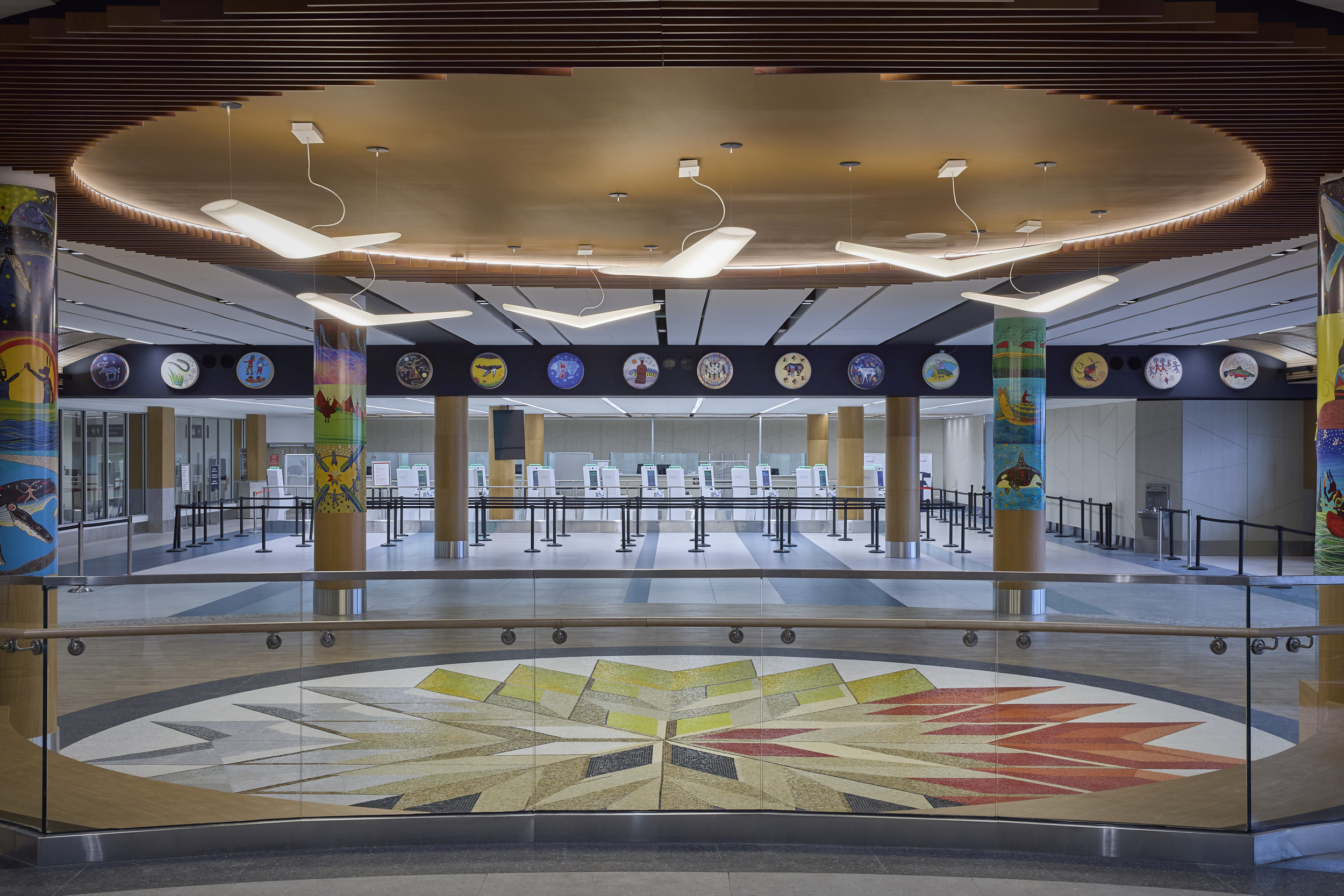
For many travelers, the airport arrivals hall frames the first real moment of a destination. At Halifax Stanfield International Airport, that first impression now carries a clear message: welcome to Nova Scotia, and welcome to Mi’kma’ki.
Halifax Stanfield International Airport last week celebrated the grand opening of its newly completed International Connections Facility (ICF), unveiling a renovated international arrivals space designed to reflect the culture and identity of the province while also strengthening the airport’s international connectivity. The milestone marks the final phase of the project, following the opening of the upper-level last year.

“The construction of the new ICF enabled us to reimagine the international arrivals experience,” said Dean Bouchard, Vice President, Airport Planning and Development at Halifax International Airport Authority (HIAA). “As a key opportunity to demonstrate the culture and heritage of Nova Scotia to travellers arriving here, we knew it was important to create a strong sense of place that pays tribute to the very first peoples of these lands.”
That emphasis on place-making is increasingly common as airports modernize terminals not only to move people efficiently, but to serve as community gateways as spaces that reflect local history, art, and identity. In an era when airports are competing for new service and travelers have higher expectations for what a “welcome” feels like, terminals are becoming part of a region’s narrative, not just its infrastructure.
But Halifax Stanfield’s ICF isn’t only about aesthetics. The airport says the project will support increased passenger traffic and cargo capacity, improve international-to-domestic connections, and strengthen Halifax Stanfield’s position as a Canadian gateway, an important step as Atlantic Canada looks to expand access to global markets and build economic resilience through stronger transportation links.
Those practical benefits, from smoother connections to greater cargo capability, are the type of outcomes increasingly tied to airport modernization projects across the industry: improvements that support passenger experience, but also strengthen supply chains and regional growth.
That framing was echoed by Minister of Transport Steven MacKinnon, who highlighted the broader impact of the investment.
“Our government is proud to support projects that strengthen Canada’s supply chains and improve connectivity for travellers and businesses alike,” MacKinnon said. “The new International Connections Facility at Halifax Stanfield is a perfect example of how strategic investments can enhance efficiency, and position Canada as a global gateway. These improvements will help move people and goods faster and more reliably, creating economic opportunities for communities across Atlantic Canada and beyond.”
The project was supported through a mix of partners and funding sources, with Transport Canada contributing $8.3 million, the Government of Nova Scotia investing $3 million, and HIAA contributing more than $6.5 million.

What distinguishes Halifax’s renovation, however, is how intentionally the new space was shaped by community collaboration. Halifax Stanfield says the redesigned international arrivals area was built through in-depth Mi’kmaq community engagements, with the goal of creating an authentic arrival experience centered on Mi’kmaq culture and the traditions of Mi’kma’ki.
Inside the refreshed facility, that identity is expressed through signature pieces created by local Mi’kmaq artists, including a 26-foot flooring centerpiece featuring an eight-pointed star designed by Stephen Francis of Eskasoni. The space also includes a living wall of live plants and artwork by Mi’kmaq artist Alan Syliboy of Millbrook across six pillars, along with 14 drums from Syliboy’s Daily Drum collection featured along the upper walls.
The result is a space that aims to do two things at once: support the efficient movement of people and goods and ensure that for international travelers arriving in Halifax, the first experience of the region is one rooted in welcome, meaning, and a genuine sense of place.
